Le Mars Drywall Repair
(712) 938-1506Call 7 days, 7am–9pm

Drywall Repair in Le Mars, IA

A brown ring after the February thaw, a seam that split while the furnace ran, a hole, a dented corner, a soft patch of old plaster: all of it can be put right. A Le Mars-area pro quotes the job, repairs it, copies your texture and hands the surface back ready to paint.

Repairs arranged in Le Mars and in Remsen, Merrill, Hinton, Kingsley, Akron, Oyens and Struble.

Call 7 days, 7am–9pm

Ring us, and a drywall pro working nearby calls back for the details, then sets up your quote.

Tell us about the damage

From here, a local drywall pro picks up your note and phones to talk the damage over and sort out a price.

01 Pinhole to ceiling panel: sizing the repair

Most people want to know first whether this is a small fix or a big project. Size answers that better than anything, because it settles the number of coats, the waiting between them, whether fresh board has to go in and how wide the texture needs blending.

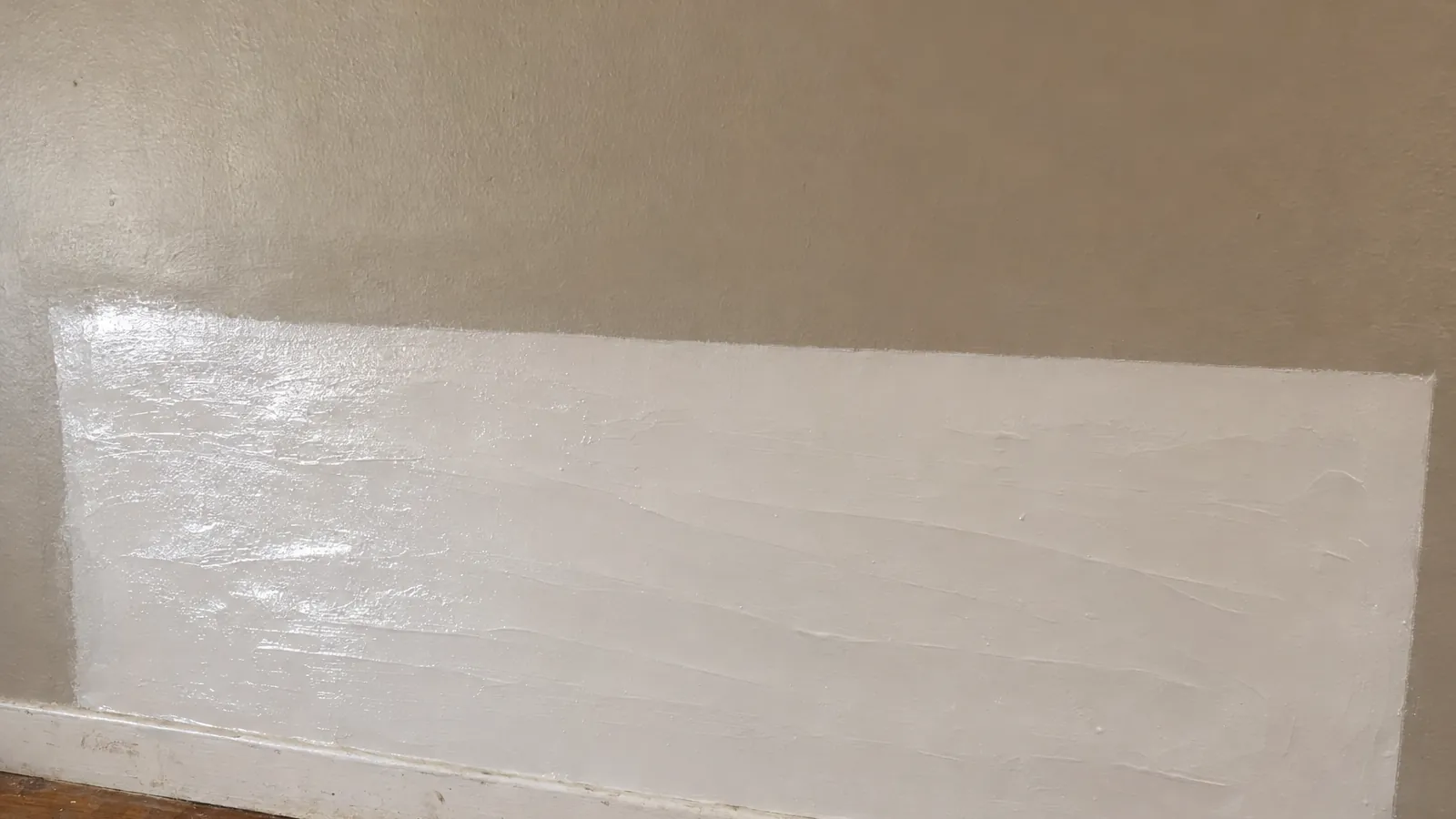
A wide band of glossy wet joint compound spread across the lower part of a beige wall, just above a white baseboard.
Fresh compound spread wide above a baseboard. It needs to dry right through before sanding and the following coat.

Small repairs

Popped nails, shelf-bracket holes, a doorknob dimple, a short hairline. These get spackled or hidden under a palm-sized patch, then built up thinly two or three times, with drying and a light sanding in between. Since it all happens in one spot, the paint touch-up stays modest.

Medium repairs

A hole you could push a fist through, a seam torn open for several feet, or an outside corner caved in by furniture. Here the ragged edges get squared off into a tidy rectangle, a backer goes behind, a new gypsum square is screwed in and taped, and compound is spread out generously past the joints so no hump shows. Corners get new metal bead first.

Large repairs

A stained ceiling section, the lower strip of a wet basement wall, or a run of plaster coming loose from its lath. Expect cutting back until solid material is reached, a look at what sits behind, new sheets hung and a broad area finished. With waiting between coats, a job like this normally stretches past a single day.

Can't tell which column yours belongs in? Two pictures sent from your phone usually settle it.

02 Stains, lines and bumps decoded

A mark on the ceiling looks worse before you know where it came from. Nearly every one has a short list of usual causes, and naming the cause is what turns a worry into a plan. Below are the signs Le Mars homeowners tend to notice, each paired with the page that goes deeper.

Three drawn wall panels showing common crack shapes: a hairline crack running down from the corner where wall meets ceiling, a diagonal crack rising from the top corner of a door frame, and a straight crack following a taped vertical seam.Hairline from a room cornerDiagonal from a door cornerStraight line along a seam
Corner hairlines usually come from seasonal framing movement, diagonal door cracks from stress at the opening, and seam lines from tape or compound letting go.
A coffee-colored blotch on an upper-floor ceiling during a thaw
Typically beside an outer wall. Meltwater backing up behind an ice dam is the usual reason; see fixing a ceiling an ice dam has soaked.
A ceiling belly sagging between joists
Water may be sitting on top of the board. First move: at the breaker box, cut the circuit feeding the nearest overhead fixture. Next, keep the floor below empty of people, and phone. The wet-ceiling first steps cover what comes next.
A pencil-thin line tracing a joint, or tape bubbling loose
Usually seasonal framing movement plus months of dry furnace air. Read about mending split seams and cracks.
Coin-sized bumps lined up down a wall
Nail pops, where fasteners have crept outward as studs dried. The section on popped nails explains the fix.
A spiderweb of cracks on an old wall, or a patch that flexes under your palm
Plaster parting company with its lath strips. See repairing old plaster walls.
A tide mark or a crumbly lower edge in the basement
Floor water climbing into the gypsum, often wetter higher up than the stain suggests. Start with getting basement drywall dry and rebuilt.

03 Four repair types, one phone call

Every page below explains what tends to cause the damage, what a careful drywall repair consists of and which questions are worth raising up front. Holes, dents and corner damage can ride along with any of them, so bring those up as well.

Thaw-season ceiling leaks

Rings, soft spots and bellies on upper-floor ceilings after snowmelt backs up, fixed once the wet gypsum has been located and allowed to dry.

Ceilings after snowmelt leaks

Seams, cracks and pops

Split joint tape, hairlines, door-corner diagonals and popped fasteners, re-taped with hard-setting compound so they tend to stay closed longer.

Wall and ceiling crack repair

Old plaster and lath

Loose, bulging and webbed plaster in pre-war houses, pinned back to its lath or patched and worked into the old face.

Plaster patching for older homes

Basement drywall after a soaking

Stained, swollen or crumbling lower drywall removed, the cavity dried, and the wall rebuilt after water has crossed the floor.

Water-damaged drywall in basements

04 The plan in five stages

Most of the stress in a repair comes from not knowing the sequence. Here it is, from your first message to a surface you can roll paint onto. The about page has more on who handles what along the way.

  1. Your call, text or form

    Mention the room, roughly how large, and if anything feels damp. A snapshot that includes a ruler explains a lot.

  2. A callback from the pro

    The drywall pro from nearby studies your pictures, asks what you have spotted and describes the likely fix in plain terms.

  3. Numbers settled first

    Scope and price get settled before anyone opens up the wall. Where a stain might hide damp board, the quote says how that case will be treated.

  4. Board, tape and coats

    Spoiled material is removed, new gypsum or plaster fills the gap, joints are taped, and each coat cures ahead of the next layer.

  5. Blended, primed, ready for your roller

    The new surface is given the same texture as its surroundings and finished either primed or paint-ready, whichever you settled on.

05 Levers on the final price

A price that creeps upward halfway through is what people dread, so here is what actually moves it. As a broad yardstick only, Fixr's drywall repair price page, revised January 2025, shows about $200 to $550 for a typical job, about $60 to $200 for a hole, about $60 to $330 for a crack and about $400 to $800 for water-damaged drywall. Fixr compiles those nationally; they are not Le Mars rates, and your own quote is what matters.

  • How much, and how many. A single patch runs less than spots scattered through the house, though Fixr adds that bundling several rooms into one trip works out more cost-effective.
  • Overhead or eye level. Ceilings mean ladders, drop cloths and awkward reaching, and Fixr rates them slightly dearer than walls.
  • Surface finish. Smooth walls need wide, careful feathering. Orange peel, knockdown or popcorn must be copied from what is there, an extra step.
  • Dampness. Soggy board either dries out or gets replaced, and soaked attic insulation widens the job.
  • Plaster. Old walls frequently need pinning back and more build-up coats before finishing.
  • Painting. Whether primer and paint are included or you take that part on.

06 Two historic districts, two kinds of wall

Two of the districts Le Mars has on the National Register are packed with older buildings whose walls act differently from modern gypsum. Knowing which kind you live with sharpens the plan from the start.

Foster Park Historic District

The district spreads over the 500 to 900 blocks of Central Avenue South and the streets around Foster Park. Its houses went up mostly between the 1880s and the 1930s, built in frame, brick or stucco and standing one to two and a half stories. Homes from that stretch usually had three-coat plaster on wood strips called lath, so a crack there often means plaster pulling loose, and a repair must finish level with a hard, glassy face.

The brick downtown blocks

The Downtown Commercial Historic District is bounded by 2nd Street North, 2nd Avenue West, 1st Street South and 1st Avenue East. Its red and buff brick buildings date from roughly 1879 to 1958 and rise one to three stories, and their upper floors have housed meeting halls, offices and apartments. Inside walls built against old masonry can crack or show damp patches, so the cause deserves a look ahead of any patching.

Houses built after plaster gave way to gypsum board usually show popped nails and opened seams instead, which is a more straightforward repair.

07 Gather these five things first

Diagnosing it is not your job. A few notes trim the first phone conversation and sharpen the quote.

  1. Two kinds of picture. A wide shot with the entire wall or ceiling in it, and a tight one with a dollar bill or ruler laid beside the damage.
  2. Rough measurements. Height and width of the damaged patch, plus how high the ceiling is if it is overhead.
  3. Breaker off under a wet ceiling. If a ceiling is drooping or dripping, flip that room's ceiling-fixture breaker off first, then keep everyone, animals too, well away and put a pail where the drips land.
  4. When you first noticed it. Right after a thaw, during a downpour, after a move-out, or creeping along all winter: the timing hints at the cause.
  5. Paint and texture. Jot down the paint color if the old can is around, plus a word on texture: flat smooth or bumpy.

08 Plymouth County towns on the list

Le Mars is the seat of Plymouth County and lies on the Floyd River, northeast of Sioux City. Repairs are arranged throughout town and in the small cities that ring it.

Map of Le Mars and the 7 nearby towns served, with Le Mars at the center. Struble lies to the north; Oyens lies to the east-northeast; Remsen lies to the east; Kingsley lies to the southeast; Hinton lies to the south-southwest; Merrill lies to the southwest; Akron lies to the west.StrubleOyensRemsenKingsleyHintonMerrillAkronLe MarsN
  • Struble, about seven miles north
  • Oyens and Remsen, to the east
  • Kingsley, to the southeast
  • Merrill and Hinton, down toward Sioux City
  • Akron, farther out to the west

Areas served, with a note on each town

09 Water got in: the order of things

Water inside a wall makes everyone want to act at once. Moving promptly is sensible, yet getting the sequence right counts for more than raw speed, and it keeps the final repair smaller.

  1. Shut it off. For a plumbing leak, close the valve at the fixture or at the main. For an ice dam, Minnesota Extension's ice dam guidance lists raking roof snow and opening a drainage path through the ice as stopgaps, and recommends leaving winter roof work to professionals.
  2. Make it safe. Cut electricity to fixtures beneath a soaked ceiling, drag furniture and rugs aside and keep the area under a sag empty.
  3. Dry everything. Fans, a dehumidifier and cross-ventilation do the heavy lifting. Extension guidance is clear that interior repairs should wait until walls and ceilings have dried.
  4. Test, then choose. Meter readings show when the gypsum has dried. Board that stays spongy, flakes apart at the edge or smells of mildew usually comes out; board that firmed up again with nothing more than a ring may only want a sealing primer before finishing.
  5. Rebuild. Patch, tape, coats and texture follow as normal. The basement flood cut, step by step and the ceiling stain-or-replace table go further.

10 One call, and the worry gets smaller

However the damage looks today, getting started takes one step: ring, send a snapshot from your phone, or leave a message, and the plan grows from there.

One call gets it moving: a nearby pro phones back to discuss the wall and settle on a price.

Call (712) 938-1506Text a photo